In a creative slump or simply want to up the game of your video editing projects? Here’s a few reasons why your editing may be suffering.
If you want to improve your video editing skills, you need to uncover the issues that may be holding you back. Sometimes these problems are obvious, but when you’re learning, you may not even be aware of what you don’t know. Editing is heavily influenced by script writing – understanding how to shape the storytelling arc, distribute information, develop characters, and much more. I recently stumbled upon an article on io9.com that shared some statistical analysis conducted by FiveThirtyEight:
The data-crunching fiends over at Five Thirty Eight examined the data from thousands of script evaluations of screenplays by newbie writers, submitted to the Black List of unproduced screenplays. And they found that science fiction and comedies have the worst ratings of all — as well as the reasons why these scripts often crash and burn.
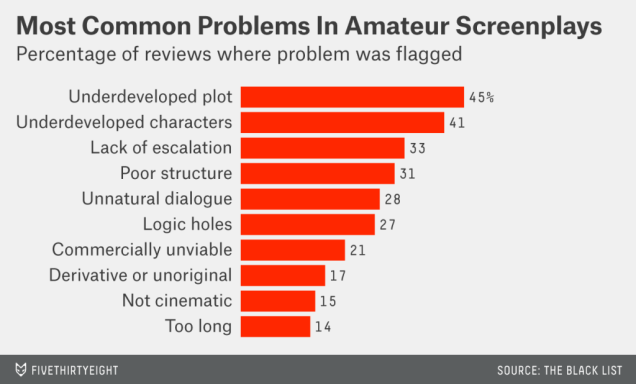
Interestingly, many of the problems highlighted in the chart above can also be directly applied to editing. However, I thought it would be intriguing to create a hypothetical list of the top 5 most common problems editors face when editing, which will hopefully assist you in enhancing your own work.
Common Problems with Amateur Editing

1. Too Long
One of the most prevalent issues with amateur or inexperienced editors is that their work is WAY too long. They haven’t edited it down to be as tight and concise as possible. They’ve essentially stopped editing before they should have.
There’s a common phrase in post-production: ‘murder your darlings’. Just because a scene was challenging to shoot or just because you’re particularly attached to a certain sequence or shot, cut these ‘darlings’ if they don’t serve the best interest of the project.
It’s essential that your project is structured as tightly as possible. If it takes 3 hours to tell your story, that’s fine, as long as you have 3 hours of story (although this is rarely the case!). Keep it succinct.
2. Boring/Lack of Creativity
As a result of being too long, the work often becomes boring. There may be a great story hidden somewhere, but it’s not shining through. Or there’s so little creativity in the mix that it may be ‘correct’, but it’s not interesting. Simply cutting to someone because they have the next line of dialogue is not engaging. Trim the unnecessary parts, rearrange elements, add new lines of dialogue, break some rules, and inject creativity into the project. Your audience will appreciate it.
3. Sound Problems
Many new editors often overlook the importance of the colorful bars flashing up and down on the audio meters. These bars provide valuable information – indicating whether your audio is too quiet, too loud, or just right. Sound makes up 60 percent (at least!) of your final product, so it deserves focused time and attention. At the very least, ensure that your dialogue is mixed at a consistent level, audible, and smoothed out with atmospheric sound/room tone filling in any gaps.
Make sure to mix your music appropriately, filling the soundscape where necessary and supporting the scene at a lower level when appropriate. Avoid simply slapping it in at one level.

4. Lack of Attention to Detail
One of the key differences between a junior editor and a senior one is the level of attention to detail.
Ensure that you meticulously check:
- All spelling, font size, and alignment
- Sound mix falls within acceptable ranges
- Color grade is finalized and consistent between shots
- Stabilization has been applied to necessary shots
The best way to stay fresh is to have multiple individuals review the final edit. Encourage them to provide feedback and be on the lookout for any technical errors. This will quickly highlight areas that require attention.
5. Not Enough Heart
This last common editing problem (which is often related to projects being overly long) is the lack of heart. Where is the human story, the emotions, the opinions, the characters that will make me care about what I’m watching? While this also depends on the script, actors, and story structure, a significant part of this vision comes to life in the edit.
If there’s no heart, no human touch, then the project will feel dry. Sometimes, even a small touch can make a big difference.
Share Your Thoughts!
These are just five common problems that I believe editors often face, but I invite you to share your own problems and solutions in the comments section!

Other Articles
Choosing the Best Aspect Ratio for Your Video
5 Brands That Set New Standards in Virtual Reality Content