Get ready to be inspired by director Adam Salky as he talks about his approach to filmmaking and his recent project “I Smile Back” with Sarah Silverman. While technical tools and practices of cinematography are important, the most fundamental element of storytelling is often overlooked by new cinematographers: the art of directing. In “I Smile Back,” Salky captures the real-life challenges of mental illness in a family dynamic, shedding new light and a deeper understanding of how it affects real people. Both “Dare” and “I Smile Back” are beautifully executed films that concentrate on delicate and emotional stories, something that Salky aspires to convey in his own work. Learn more about his journey and the incredible cast he worked with in our conversation below.
PB: How do you maintain your artistic vision when working with major studios and distributors for films like Dare and I Smile Back? Did you have to compromise your artistic intentions to appeal to a wider audience?
AS: Fortunately, both Dare and I Smile Back were independent films, which allowed for a lot of creative freedom. With indies, you make the film on your own outside of the marketplace, and then try to sell it at a place like Sundance Film Festival. That’s where you find out if your artistic cinematic effort has any appeal to commercial buyers. I feel very lucky that both films received wonderful critical notices and had theatrical releases. They can now be rented or bought on disc and streamed online or through smart apps on TV, Roku, Apple TV, etc.
PB: Can you tell us about your role in the casting process and how you came to cast Sarah Silverman in I Smile Back?

Mandatory Credit: Photo by Broadimage/REX/Shutterstock (10048859bb) – Sarah Silverman – Sean Penn J/P Haitian Relief Organization, Arrivals, The Wiltern, Los Angeles, USA – 05 Jan 2019
AS: I am very hands-on with casting. I go to sessions, work with the actors who come in, and I try to get a feel if they’re right for the part and if I can work with them. Sarah is an interesting case because she was actually attached to the film for four years before I got involved. Amy Koppelman, the writer of the novel and the co-writer of the screenplay, heard Sarah on Howard Stern’s show talking about her autobiography and had the inspiration that she would understand the role. They got the book to Sarah, who read it and, as the story goes, told Amy that if she wrote a script and “it doesn’t suck” that she would do it. Four years and a few directors later, they met me. Seven months after that we started shooting.
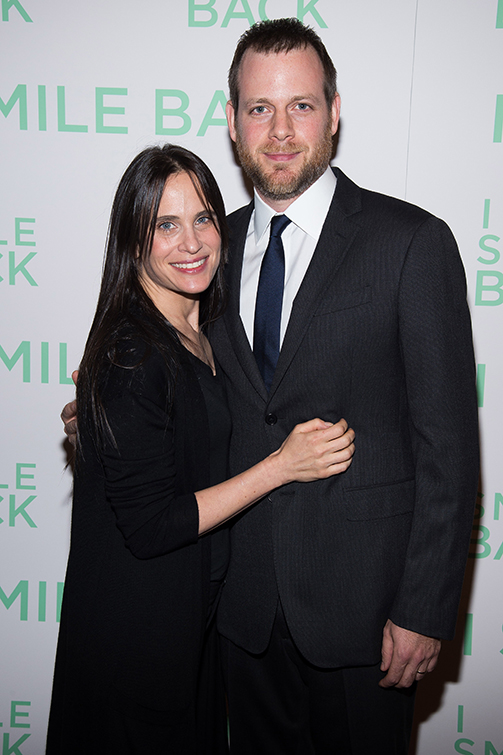
Mandatory Credit: Photo by Charles Sykes/Invision/AP/REX/Shutterstock (9081687q) – Amy Koppelman and Adam Salky attend a special screening of “I Smile Back” at The Museum of Modern Art, in New York, NY Special Screening of “I Smile Back”, New York, USA.
PB: How long did it take to film I Smile Back? Can you describe the rehearsal process with the actors?
AS: It took twenty very full and challenging days to film I Smile Back. Most independent films have zero rehearsal because there usually isn’t money to pay the actors to commit the time. On I Smile Back, I was lucky to be in touch with Sarah from the moment I became involved. We met in person and spoke many times over the phone about the character, different scenes, and story moments. Then, as we got closer to production, we had two extremely helpful, multi-hour rehearsal sessions where we read through the script with the whole cast and worked on a particularly tough scene the night before we shot it. I love rehearsal and say use as much as you can get.
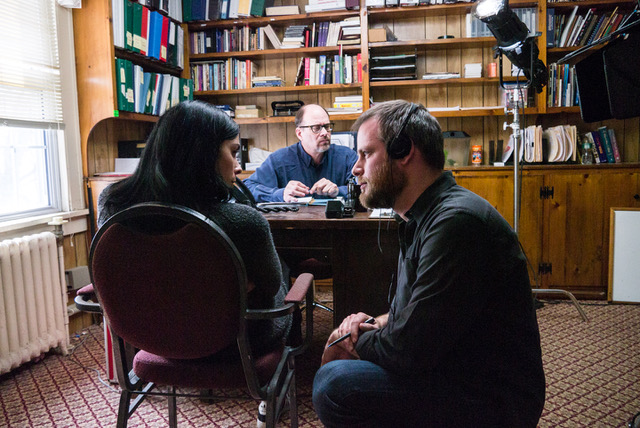
Image via Jeong Park.
PB: How do you handle giving feedback to an actor when the scene requires deeply emotional and painful actions, like in the scene where Sarah’s character hits rock bottom in her daughter’s room with the teddy bear?
AS: I’m so glad you singled out that moment because it’s one of my favorites in the film. Filming it was also one of the high points of the production because of the way the crew rallied to rise to the occasion. As a director, I think setting the tone for delicate scenes begins on day one when you first meet your cast and start building your team. If you’re prepared, calm, and you authentically know the story you’re telling, then you build goodwill and trust with your collaborators. By the time you get to the intimate scene, you are all on the same page and ready. I think it’s really hard to set the tone on that day. If you have to do that, you may have done something wrong a long time ago. As for giving feedback, I try to be as specific as possible and give the actor the space to explore themselves for such a deep performance.
On set, I Smile Back had a certain seriousness to it because of the material and all of the people involved who felt so strongly about telling this story. It was also a very ambitious, twenty-day shoot. We were “making” every day by the skin of our teeth, which required intense focus. That being said, we did laugh, and Sarah had a couple of really funny running jokes that kept us smiling. Also, the kids played by Skylar Gaertner and Shayne Coleman were so fun and funny and always brightened the set when they were around.
Filmmaking is a marathon, and every artist must find the thing(s) that can sustain them while they work to set up their careers. Adam Salky, the head of the directing discipline at The AFI Conservatory, found his thing in teaching. But for young filmmakers, the balance of commercial and artistic work is not a one-size-fits-all answer. Salky advises them to set out to make the films they want to make, and if they end up being commercial, then great. If not, they should find that thing that can sustain them while they work towards their goals.
As for directing child actors in a dramatic scene, Salky treats them like young adults and does not talk down to them. He believes that rolling the camera without saying “action” can capture some natural moments.
While a technical background is not essential for a director, Salky’s experience in editing, camera, and crewing has served him well. He believes that a command of story is paramount, and the ability to communicate that story to the team is crucial. The director designs the experience of the film in the same way an architect designs a building. Every creative choice is made to achieve the goal of creating a unified film that says the thing you set out to say.
Salky’s work in film is a reminder that substance, vibe, and subtleties are more powerful storytelling tools than any piece of equipment. His films, I Smile Back and Dare, engage audiences in a thoughtful way and leave a lasting impact. Aspiring filmmakers can learn a lot from Salky’s thoughtful perspective and apply it to their own endeavors in the motion picture medium.

Other Articles

New Augmented Reality Film Utilizes Magazine Cover as Screen
Improve Your Commercial Treatments with These Writing Tips